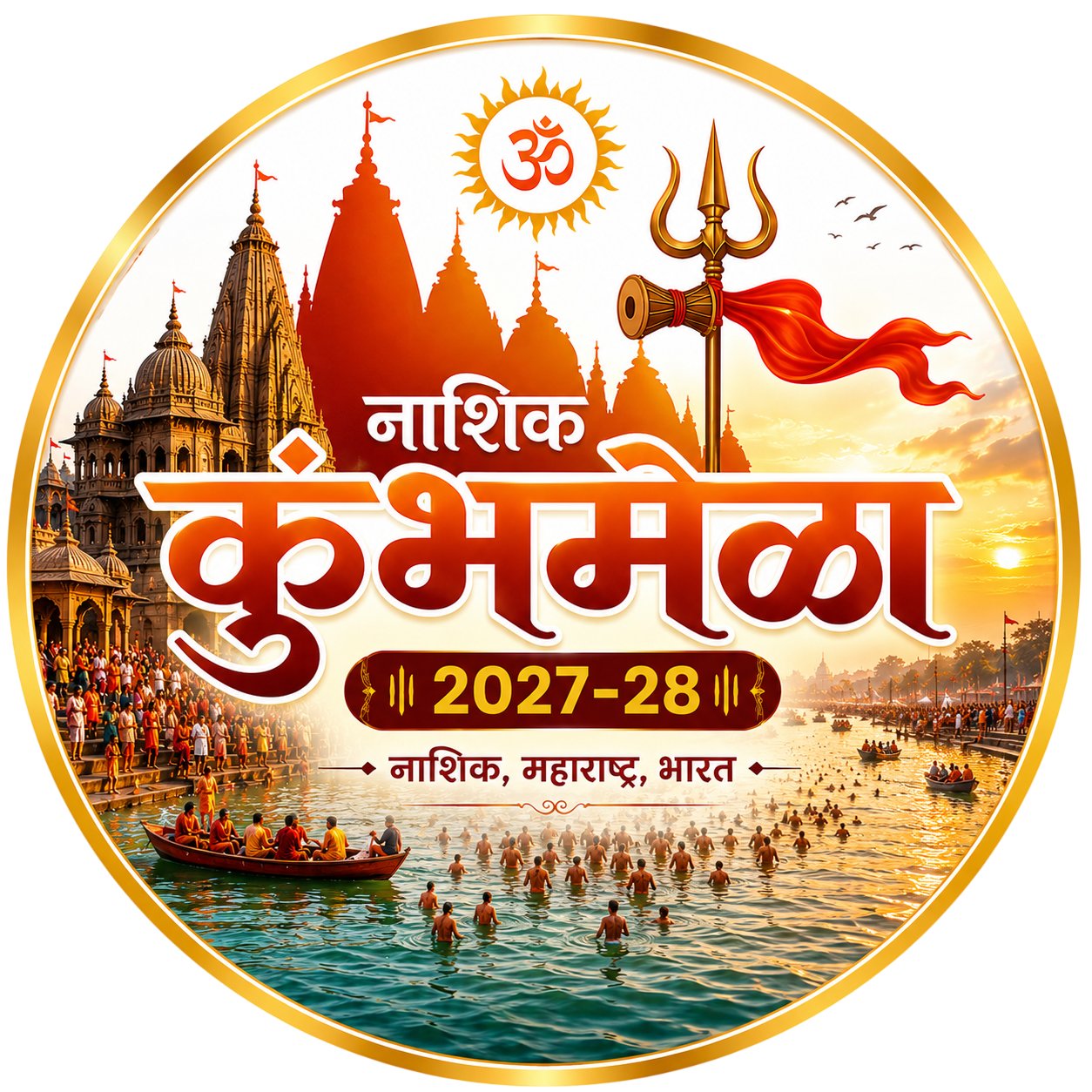
A pilgrimage older than written memory — born of myth, carried by sadhus, and renewed every twelve years on the banks of India's holiest rivers.
The story of Kumbh begins with the Samudra Manthan, the great churning of the cosmic ocean by the Devas (gods) and the Asuras (demons) in search of Amrit, the nectar of immortality. After a thousand years of churning Mount Mandara on the back of Lord Vishnu's tortoise avatar, the divine physician Dhanvantari emerged from the waters holding a sacred pot — the Kumbh — filled with the nectar.
Fearing the demons would seize immortality, Lord Vishnu's mount Garuda took flight with the pot. During the twelve celestial days of the chase — equivalent to twelve human years — four drops of Amrit fell to the earth at Prayagraj, Haridwar, Ujjain, and Nashik.
Each of the four sites is associated with a holy river: the Ganga–Yamuna–Saraswati Sangam at Prayagraj, the Ganga at Haridwar, the Shipra at Ujjain, and the Godavari at Nashik. The Kumbh rotates among these cities every three years, returning to each in a twelve-year cycle aligned with the movements of Jupiter, the Sun and the Moon.
Nashik's Kumbh is uniquely called Sinhastha because it occurs when Jupiter enters the zodiac sign of Leo (Sinha) — a configuration believed to magnify the spiritual potency of bathing in the Godavari to its absolute peak.
The Chinese pilgrim Xuanzang, who visited India in the 7th century CE during the reign of Emperor Harsha, left the earliest detailed written account of a Kumbh-like gathering at Prayag. He described a vast assembly of monks, ascetics and emperors gathering to give away their wealth and bathe in the sacred confluence.
The institution of the Akhadas — the militant monastic orders that lead the Amrit Snan (Shahi Snan) processions — was formalised by Adi Shankaracharya in the 8th century CE to defend Sanatana Dharma and to bring order to the immense crowds.
Trimbakeshwar is also one of the twelve sacred Jyotirlingas of Lord Shiva, and the source of the Godavari — revered as the Dakshin Ganga, "the Ganges of the South" — which originates nearby at the Brahmagiri hills. The temple town is also home to the Samadhi of Sant Nivruttinath, founder of the Nath Sampradaya. A historic arrangement made by the Peshwas keeps the traditions apart during the Kumbh: Vaishnav Akhadas bathe at Ramkund in Nashik, while Shaiva and Sanyasi Akhadas bathe separately at Trimbakeshwar — a division still observed today to prevent the sectarian clashes that once occurred when all orders gathered at a single ghat.
Today the Kumbh is recognised by UNESCO as an Intangible Cultural Heritage of Humanity, and routinely ranks as the largest peaceful gathering of human beings on Earth. The 2019 Prayagraj Ardh Kumbh drew over 240 million pilgrims; the 2027 Nashik Sinhastha is expected to welcome more than 12 crore devotees.
Every Kumbh is a living continuum — three thousand years of myth, ritual and faith renewed at the river's edge, exactly as it has always been.
Budget Rooms in Nashik | Guest Houses in Nashik | Hotels in Nashik | Lodges in Nashik | Tent Bookings in Nashik
Astrologers in Nashik | Autos/Taxis in Nashik | Bus Services in Nashik | Car Rentals in Nashik | Hospitals in Nashik | Pandits in Nashik | Puja Bookings in Nashik | Tour & Travels in Nashik
Shree Sant Nivruttinath Maharaj Samadhi Mandir, Trimbakeshwar, Nashik | Shri Swaminarayan Mandir, Nashik | Kevdiban Mhasoba Maharaj Temple, Nashik | Tringalwadi Fort, Igatpuri, Nashik | Ghatandevi Temple, Igatpuri, Nashik | Dhamma Giri Vipassana Centre, Igatpuri, Nashik | Vaitarna Dam, Igatpuri, Nashik | Kushavarta Kund, Trimbakeshwar, Nashik | Renuka Mata Mandir, Chandwad, Nashik | Ganga Godavari Temple, Nashik | Kalsubai Trek, Nashik | Ramshej Fort, Nashik | View all in Attractions of Nashik